


Meta is a prefix that comes from the Greek word metá (μετά) and adds the sense of "after, beyond, at a higher level" or "about itself" to the word it is attached to. Used on its own today, it most often refers to Meta Platforms, the parent company of Facebook, Instagram and WhatsApp; to the most effective strategy of the moment in games; and to the meta tags in web pages. Turkish also has a completely separate word, "meta", of Arabic origin, which means "goods, merchandise".
In short, there is no single answer to the question "what does meta mean?"; the right meaning depends on the sentence the word appears in. The list below summarizes the meanings you are most likely to come across.
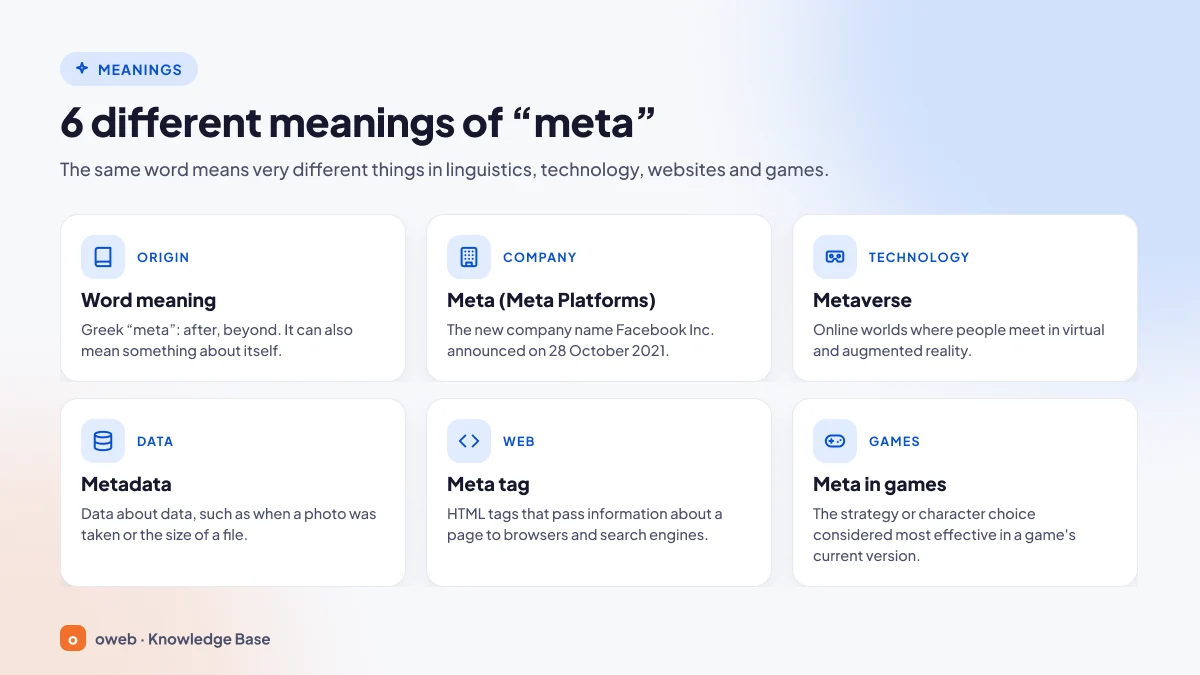
The 6 most common meanings of meta
- The prefix meta- (Greek): Adds the sense of "after, beyond, change, higher level"; you can see it in words such as metaphysics, metaphor and metamorphosis.
- Meta (a Turkish word of Arabic origin): According to the Turkish Language Association (TDK), it means "goods, merchandise" and, in commerce, "capital".
- Meta Platforms: The new name the Facebook company adopted on October 28, 2021; Facebook, Instagram, WhatsApp, Messenger and Threads all belong to this company.
- Metaverse: The idea of persistent virtual worlds where people come together as avatars.
- Metadata and meta tags: Metadata means "data about data"; the date a photo was taken is one example. The meta tags in a web page's code are also a type of metadata that provides information about the page.
- Gaming and internet slang: In games, the meta is the strategy or character considered most effective at the time; in everyday language, "so meta" describes content that refers to itself.
What does meta mean? Origin and meaning of the word
Most of the meanings "meta" carries today grow out of a small Ancient Greek preposition: metá. According to etymological dictionaries, it is related to the reconstructed Proto-Indo-European root *me-, meaning "in the middle". The earliest known written example of the word is the form me-ta on Linear B tablets written in Mycenaean Greek. In other words, "meta" was in use thousands of years before Meta the company, or the internet, existed.
The three core meanings of the Greek prefix meta-
In Greek, metá expresses different relationships depending on context. In the words that have passed into English and other European languages, three groups of meaning stand out:
- After, behind, among: Indicates time or position. The sense "with, alongside" is close to this group.
- Change, transformation: Describes a shift from one state to another. Metamorphosis and metabolism carry this meaning.
- Beyond, at a higher level: Expresses going past the limits of something or looking at it from a level above. Metaphysics, through the interpretation it acquired later, is the best-known example of this meaning.
The name metaphysics actually came from the order of books
A curious coincidence played a part in spreading the "beyond" meaning. In the arrangement made by Andronicus of Rhodes, who edited Aristotle's works in the 1st century BC, the books dealing with the first principles of being were placed after the Physics, so they were called "the ones after the Physics" (ta meta ta physika). The name is traditionally attributed to Andronicus, although some scholars note that the arrangement may be older.
So metaphysics originally meant nothing more than "the books that come after the Physics". Latin writers later interpreted the name as "the science of things beyond physics", and the prefix meta- settled into European languages with the sense "beyond, above". In English, the free use of meta- to coin new words also arose as a back-formation from the word metaphysics.
The "about itself" meaning is a 20th-century development
The sense most discussed today, "an X about X", is relatively new. In the early 1920s the mathematician David Hilbert developed the idea of metamathematics, the study of mathematics itself; in 1937 the logician W. V. O. Quine used the term metatheorem. The work that brought this meaning to a wide audience was Douglas Hofstadter's 1979 book Gödel, Escher, Bach. The spread of the English expression "going meta" (moving a discussion up to a higher level of abstraction) is also largely credited to Hofstadter.
As a result, the prefix meta- gained two functions: going beyond something, and describing something by means of something of its own kind. Metalanguage (a language used to talk about language) and metadata (data about data) are typical examples of the second function.
A glossary of words beginning with meta-
All of the words below carry the same Greek prefix. Most of the older ones reached English through Latin, often by way of French.
| Word | Structure | Meaning |
|---|---|---|
| Metaphysics | meta + physika (nature, physics) | The branch of philosophy that studies the first principles of being |
| Metaphor | meta + pherein (to carry) | A figure of speech; "carrying" meaning from one domain to another |
| Metamorphosis | meta + morphē (form) | Transformation, such as a tadpole turning into a frog |
| Metabolism | metabolē (change) | All the biological and chemical changes that take place in a living organism to produce energy |
| Metastasis | meta + stasis (standing, place) | The spread of a disease, especially cancer, to another part of the body |
| Method | meta + hodos (way) | A systematic way of reaching a goal |
| Metalanguage | meta + language | A language used to describe another language |
| Metadata | meta + data | Data about data |
| Meta-analysis | meta + analysis | An analysis that statistically combines the results of several studies |
| Metacognition | meta + cognition | Awareness and control of one's own thinking processes |
Not every word that starts with "met" belongs to this family. Meter comes from the Greek metron (measure), metropolis from mētēr (mother) and polis (city), and methane was named after methyl in chemistry. The resemblance in these words is pure coincidence.
Meta in Turkish: "goods, merchandise" according to TDK
Here is the point readers most often miss: the "meta" found in Turkish dictionaries is not related to the Greek prefix. In the Turkish Language Association's TDK Güncel Türkçe Sözlük (Current Turkish Dictionary), meta (pronounced "meta:", with a long a in the final syllable) is listed as a noun of Arabic origin, from metāʿ, with the following two meanings:
- Goods, merchandise.
- (commerce) Capital.
In the Turkish sentence "Eski kervan yollarında tuz, en kolay el değiştiren metalardan biriydi." ("On the old caravan routes, salt was one of the most easily traded goods."), the word has this meaning. Although the two "meta"s are spelled the same in Turkish, they differ in origin, pronunciation and meaning; they are not two senses of one word but two entirely unrelated elements.
Emtia and metalaşma: commodities and commodification in Turkish
The Arabic plural of the word passed into Turkish as emtia; products traded on exchanges, such as gold, oil and wheat, are still called emtia (commodities) in Turkish today. Metalaşma, a term common in Turkish sociology and economics, means commodification: something turning into goods that are bought and sold. Phrases such as "eğitimin metalaşması" (the commodification of education) or "insanı bir meta gibi görmek" (treating people as commodities) are examples of this usage. In Turkish translations of Karl Marx's Capital, "meta" is also the word used for the concept rendered in English as commodity.
When reading Turkish, if "meta" appears on its own and in a commercial context, it most likely means "goods", the word of Arabic origin. If it is attached to the beginning of another word (metafor, metaveri, metaverse), it is the Greek prefix. When used as the company name, it is written with a capital letter: "Meta".
What is Meta the company? From Facebook to Meta Platforms
Meta Platforms (officially Meta Platforms, Inc.) is the US-based technology company that owns Facebook, Instagram, WhatsApp, Messenger and Threads. Its co-founder and CEO is Mark Zuckerberg, and it is headquartered in Menlo Park, California. The company reports in two main segments: Family of Apps, made up of its social apps, and Reality Labs, which covers virtual reality, augmented reality and wearable devices.
Meta is one of the largest internet companies in the world. According to the company's third-quarter 2026 results, announced on October 21, 2026, quarterly revenue was $64.60 billion, and in September 2026 an average of 3.64 billion people used at least one Meta app every day. These figures are updated every quarter; the ones given here are as of October 2026.
Why did Facebook change its name to Meta?
The Facebook company announced that it was changing its name to Meta at its Connect 2021 event on October 28, 2021. The change applied only to the parent company; the Facebook social network kept its name. The official reasons can be summed up under three headings:
- The meaning of the word: In his founder's letter, Zuckerberg wrote that he had studied the classics (Ancient Greek and Latin) and that "meta" means "beyond" in Greek. The name stood for the idea that there is always more to build.
- A brand tied to a single product: Zuckerberg said the "Facebook" brand was too closely linked to one product to represent everything the company does.
- The metaverse vision: The new name tied the company's future to the next generation of the internet, which it called the metaverse.
Critics, however, argued that the name change was intended to divert attention from the intense backlash the company was facing from lawmakers at the time; this is an interpretation, not the company's own explanation.
Following the name change, on June 9, 2022, the company's shares began trading on Nasdaq under the ticker "META", replacing "FB", which had been in use since the 2012 IPO.
Meta's apps and products
The main apps and products under the Meta umbrella are:
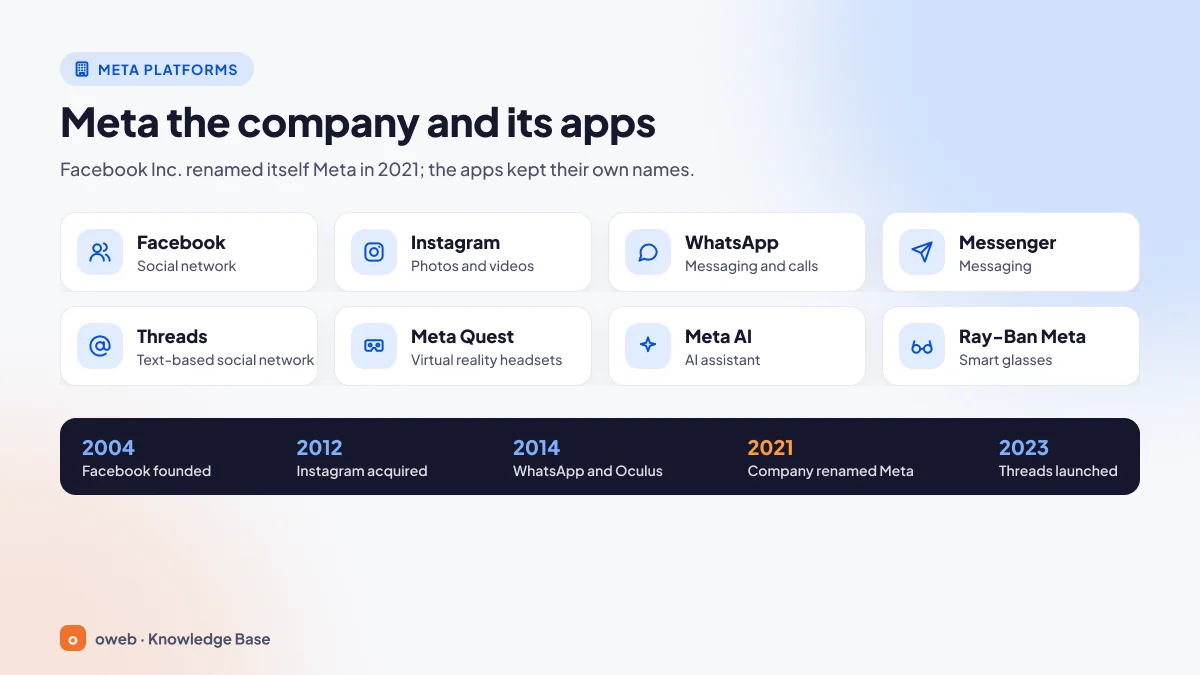
- Facebook: The company's first product, a social network; according to the latest figures Meta has reported separately, it has more than 3 billion monthly active users.
- Instagram: A platform for sharing photos, videos and Reels; it reached 3 billion monthly active users in September 2025.
- WhatsApp: A messaging app; it was announced in April 2025 that its monthly active users had passed 3 billion. To use the app on a computer, see our WhatsApp Web guide.
- Messenger: Facebook's messaging app. The mobile and web versions remain in use, while the Mac and Windows desktop apps were shut down on December 15, 2025.
- Threads: A text-based social network launched in 2023 and linked to Instagram accounts.
- Meta AI: An AI assistant built into Meta's apps and also available on the meta.ai website and in its own app; it has run on the Muse Spark model since April 2026. The company also released its Muse Wonder models on October 12, 2026.
- Smart glasses: The Ray-Ban Meta and Oakley Meta lines, made together with EssilorLuxottica, and Meta Ray-Ban Display, which has a screen in the right lens. Ray-Ban Meta Gen 3 was introduced at Connect 2026 on September 23, 2026.
- Meta Quest: The Quest 3 and Quest 3S virtual reality headsets, which run Meta Horizon OS.
- Business tools: Meta Business Suite for managing pages and messages, Ads Manager for advertising, and Meta Pixel (formerly Facebook Pixel), which measures conversions on websites.
A short timeline
- 2004: Facebook was founded by Mark Zuckerberg and his college friends.
- 2012: The company went public and its shares began trading under the ticker "FB"; Instagram was acquired the same year.
- 2014: WhatsApp was acquired.
- October 28, 2021: The company was renamed Meta.
- June 9, 2022: The ticker changed to "META".
- 2023: Threads launched.
- June 2025: The AI teams were brought together under Meta Superintelligence Labs.
- October 2026: The Muse Wonder models were released; third-quarter 2026 results were announced.
"Meta" and "Facebook" are not the same thing. Meta is the name of the company; Facebook is one of that company's apps. Instagram and WhatsApp also belong to Meta, but they are not part of Facebook.
What is the metaverse?
The word metaverse is a blend of "meta" (beyond) and "universe". It describes the idea of always-on, three-dimensional virtual worlds where people meet, work, play games and shop as avatars. There is no single agreed definition, and the term is often used loosely for virtual and augmented reality experiences in general.
The term first appeared in Snow Crash, Neal Stephenson's 1992 science fiction novel. In 2021 Stephenson wrote that his only connection to Meta's projects was that the company was using a term he had coined. Zuckerberg, for his part, described the metaverse as an internet you are inside of rather than one you simply look at, and said its defining quality would be a "feeling of presence".
Where does the metaverse stand today?
The metaverse moved to the center of attention with Meta's name change, but it has not spread as quickly as expected. According to calculations by secondary sources, the cumulative operating loss of Reality Labs, the division that runs Meta's investments in this area, has exceeded $80 billion since the end of 2020. In January 2026 the company made layoffs at Reality Labs, closed some VR game studios and announced that it would discontinue Horizon Workrooms (the app shut down on February 16, 2026); it said it was shifting part of its investment from the metaverse to wearable technology.
According to figures released by Meta, Reality Labs posted an operating loss of $4.13 billion on revenue of $443 million in the third quarter of 2026. In short, the idea of the metaverse lives on, but Meta's focus today has shifted to artificial intelligence and smart glasses.
What is metadata?
Metadata is data that identifies, describes or helps manage other data; in short, it is "data about data". The term is generally credited to computer scientist Philip Bagley, who introduced it in 1968. Metadata is usually divided into three groups:
- Descriptive metadata: Information that helps you find content, such as title, author, subject and keywords.
- Structural metadata: Shows how the parts of a piece of data are organized; for example, the order of chapters in an e-book.
- Administrative metadata: Management-related information such as file type, creation details and access permissions.
Everyday examples of metadata
- Photo: Camera make and model, date taken, exposure settings and location (GPS) information.
- Office document: The author's name, creation date and file size.
- Music file: Song title, artist, album and year.
- Web page: Meta tags that describe the page to search engines and social networks.
Exif: the invisible ID card of your photos
The most widely used metadata standard for storing camera and shooting information in digital photos is Exif (also written EXIF); other standards such as IPTC and XMP are also used for photos. Exif was created by JEIDA, the Japanese electronics industry association (today JEITA); the first version was released in 1995, and GPS tags were added with version 2.0 in 1997. Exif 3.0, released in May 2023, added support for UTF-8 characters.
A photo taken with a phone can carry the coordinates of the place where it was taken if location services are turned on. Most social media platforms remove this information during upload, but it usually remains in the original file when it is sent as an email attachment or through a file-sharing link. Remove the location data before sharing photos that could reveal where you live.
What are meta tags (HTML meta tags)?
A meta tag is a <meta> element in the <head> section of a web page's HTML code that gives browsers, search engines and social networks information about the page. Visitors do not see these tags on the page, yet whether special characters (such as Turkish letters like ş and ğ) display correctly, whether the page opens properly on mobile devices and how it looks in search results depend largely on them.
According to the MDN HTML reference, <meta> is an empty (void) element with no closing tag and is used with attributes such as name, content, charset and http-equiv. The <title> element, which sets the page title, is a separate element; although it is often called the "meta title", it is not technically a meta tag.
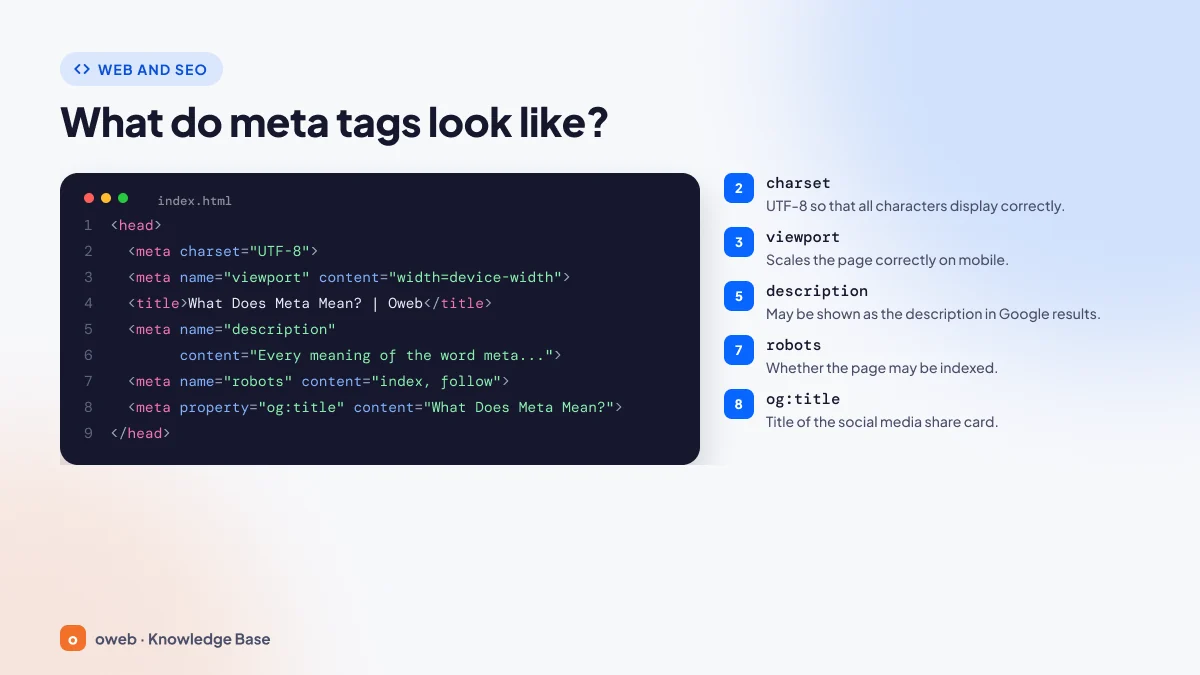
A typical page's <head> section looks like this:
<head>
  <meta charset="utf-8">
  <meta name="viewport" content="width=device-width, initial-scale=1">
  <title>What Does Meta Mean? | Example Site</title>
  <meta name="description" content="A short guide to the origin of the word meta, Meta the company, the metaverse and metadata.">
  <meta name="robots" content="max-image-preview:large">
  <meta property="og:title" content="What Does Meta Mean?">
  <meta property="og:type" content="article">
  <meta property="og:image" content="https://www.example.com/cover.webp">
  <meta property="og:url" content="https://www.example.com/what-is-meta">
</head>
The index and follow values are not included in the example; they are Google's default values and do not need to be specified.
Are the meta title and the H1 the same?
No. The <title> element sets the title shown in the browser tab and in search results, while <h1> is the main heading visitors see on the page. It is recommended that both cover the same topic, but they do not have to be identical. According to Google's documentation, the title in search results is generated automatically, using the <title>, the <h1>, og:title and other prominent text on the page. If the title is misleading or incomplete, Google may change it. There is no fixed length limit; the text is truncated according to the device width.
The main meta tags Google pays attention to
According to Google Search Central documentation, the supported meta tags that will be most useful to you are:
- charset: Declares the page's character encoding; Google recommends using UTF-8 wherever possible. According to MDN and the HTML standard, this tag must appear within the first 1024 bytes of the document, and UTF-8 is the only valid encoding in HTML5. A missing or incorrect charset tag is one of the most common reasons why accented or non-English characters, such as Turkish letters, appear garbled.
- viewport: Makes the page scale to the screen width on mobile devices; Google treats it as a signal that the page is mobile-friendly.
- description: A short summary of the page; it can serve as the source of the description text (snippet) in search results.
- robots and googlebot: Determine whether the page is indexed and how it is previewed in results.
What is a meta description, and how long should it be?
The meta description is the <meta name="description"> tag that summarizes a page's content in one or two sentences. Google usually generates the description in search results from the page content itself and uses the meta description only in some cases. Google may prefer to replace the description with text that better matches the search query, so the same page can appear with different descriptions for different searches. Even so, a well-written description is more likely to be used by Google, and because it clearly explains what the page offers, it can encourage clicks.
- Write a unique description for every page, specific to that page.
- Explain in one or two sentences, in natural language, what the page really offers; do not write a list of keywords.
- Google has no fixed character limit; the text is truncated according to the device width. As a common SEO practice, putting the most important information in the first 120-150 characters helps your message stay visible even if the text is shortened.
The robots meta tag and noindex
The robots meta tag tells search engine crawlers what to do with the page. The most commonly used values are:
noindex: The page is not shown in search results.nofollow: The links on the page are not followed.nosnippetandmax-snippet: Turn off the text preview in results or limit its length.max-image-preview: Sets the size of the image preview (none,standardorlarge).
noarchive, which appears often in older guides, is no longer used in Google Search now that Google has removed its cached-page links. In addition, according to Google's documentation, preview rules such as nosnippet and max-snippet also affect how your content is shown in AI features such as AI Overviews.
If you block a page with robots.txt, Google cannot crawl it and never sees the noindex rule inside it; if the page receives links from other sites, it can still appear in results. If you want to remove a page from the index, allow crawling and use noindex. For non-HTML files such as PDFs, the same rule is given with the X-Robots-Tag HTTP header.
Does the meta keywords tag still work?
No. The meta keywords tag was once used to declare a page's keywords. Google announced in 2009 that it does not use this tag in web ranking; according to its current documentation, the tag has no effect on indexing or ranking.
What are Open Graph (og) tags?
Open Graph is a protocol originally developed at Facebook. It determines the title, image and description shown when your link is shared on social networks or in messaging apps. The protocol's four required properties are og:title, og:type, og:image and og:url; the tags are written with the property attribute instead of name.
To manage these tags, you need access to your site's code or to a content management system. If you run WordPress on your web hosting plan, you can easily configure these settings from the admin panel with plugins such as Yoast SEO or Rank Math. If you do not have a website yet, the first step is to register a domain name that suits your brand.
What does meta mean in games?
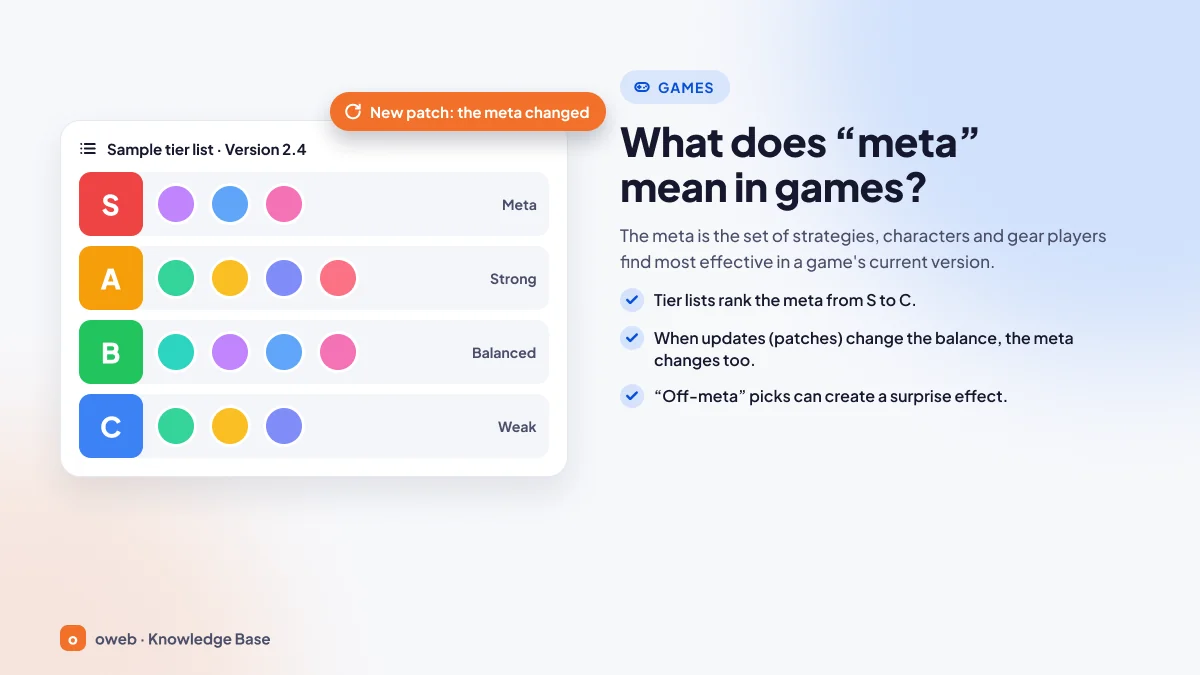
In competitive games, the meta is the strategy, character, weapon or deck considered most effective and picked most often during a given period. A player who asks "What's the meta this season?" wants to know which choices are winning the most right now. The word comes from the concept of the metagame, "the game beyond the game". The metagame is not about the rules of the game itself but about the shared knowledge and trends that players develop around those rules.
In game design, the term was popularized by Richard Garfield, the creator of Magic: The Gathering, who discussed the metagame in a 1995 column in The Duelist magazine and in a 2000 GDC talk.
Does META stand for "Most Effective Tactics Available"?
This explanation, common online, is not correct. "Most Effective Tactics Available" is an expansion fitted to the word after the fact, known in English as a backronym. It is thought to have spread in the early 2010s, particularly among MOBA player communities; who used it first is not documented. The word's real source is the Greek prefix and the concept of the metagame.
How does the meta change?
The meta is not fixed. Developers regularly release patches to balance the game: a strong character is weakened (nerfed), a weak one is strengthened (buffed), and new cards or characters are added. After every major update, players discover the new balance and a new meta soon emerges. That is why patch notes are so eagerly awaited in competitive games such as League of Legends, Valorant, Clash Royale and PUBG Mobile.
Meta expressions in gamer slang
- Meta character (meta pick): The character with the highest win rate and pick rate in the current patch.
- Meta build / meta deck: The combination of gear, abilities or cards considered most effective.
- Off-meta: A strategy that is not popular but sometimes works because it catches opponents off guard.
- "The meta has settled": After a new patch, the strongest choices have become clear.
- "Breaking the meta": Finding a new tactic that counters the strategy everyone else is using.
- Tier list: A table that ranks characters or weapons by strength into tiers such as S, A, B and C; a quick summary of the meta.
What does "so meta" mean on social media?
In everyday language, especially on social media, "meta" is used for content that is self-referential. Merriam-Webster describes this informal use as referring to something that is openly aware of being an example of its own kind and refers to itself in a clever way. A few examples:
- "This show is so meta; the characters talk as if they know they are in a TV series."
- A joke about jokes, or a meme made about internet memes (a meta joke).
- A video creator publishing a video about how they make their videos.
Meta narrative in literature and film
In literature, a text that openly reminds the reader that it is fiction is called metafiction. A narrator addressing the reader directly, a novel describing the process of its own writing, or characters who know they are in a novel are all examples of this technique. In Turkish literature, Oğuz Atay's novel Tutunamayanlar (published in English as The Disconnected) is one of the works most often cited in discussions of metafiction. In film and television, a character turning to the camera and speaking to the audience is called "breaking the fourth wall"; it is the most familiar form of meta narrative.
Meta in science and technology
Meta-analysis
Meta-analysis is a method that statistically combines the results of several scientific studies investigating the same question. The statistician Gene V. Glass coined the term in 1976 and defined it as "the analysis of analyses"; the method's precursors, however, go back to Karl Pearson's work in 1904. It is one of the key methods used, especially in medicine, to evaluate the effect of a treatment.
Metacognition
In psychology, metacognition is a person's ability to notice, monitor and manage their own thinking and learning processes. A student preparing for an exam who asks, "Do I really understand this topic, or have I just memorized it?" is practicing metacognition. The developmental psychologist John Flavell popularized the concept in the 1970s.
Meta in computing and chemistry
- Metaprogramming: Writing code that generates or modifies other programs, or itself.
- Meta sites: Sections of communities such as Stack Exchange set aside for discussing the site itself and its rules.
- The meta position in chemistry: An arrangement in which two groups are attached to carbons 1 and 3 of a benzene ring; it is mentioned together with the ortho and para positions.
Comparison table of meta concepts
The graphic and table below help you tell apart, at a glance, these concepts that are spelled so similarly.
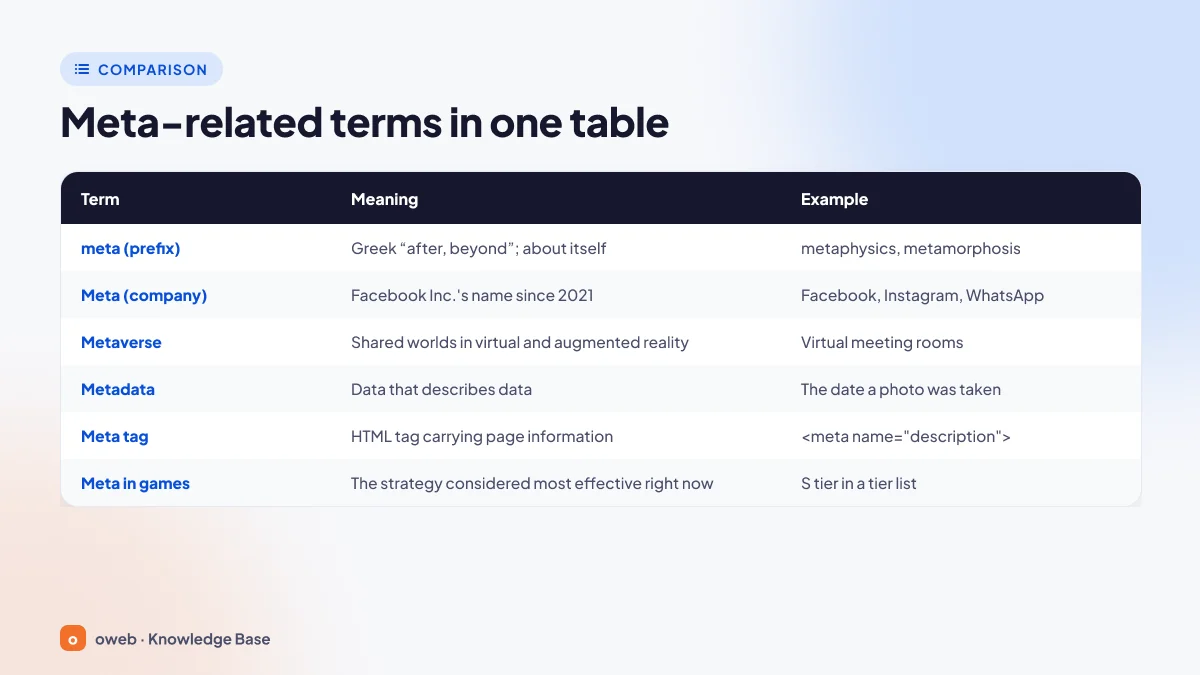
| Concept | What does it mean? | Where will you come across it? | Example sentence |
|---|---|---|---|
| meta (Turkish, of Arabic origin) | Goods, merchandise; capital | Turkish dictionaries, economics, sociology | "Bilgi de artık alınıp satılan bir meta." ("Information, too, is now a commodity bought and sold.") |
| meta- (Greek prefix) | After, beyond, change, about itself | Scientific and philosophical terms | "A metaphor carries meaning from one domain to another." |
| Meta (company) | The parent company of Facebook, Instagram and WhatsApp | Tech news, the stock market | "Instagram is an app owned by Meta." |
| Metaverse | Persistent, shared virtual worlds | Virtual reality, gaming | "I joined the meeting in the metaverse as my avatar." |
| Metadata | Data about data | Files, photos, databases | "The photo's metadata shows the date it was taken." |
| Meta tag | The <meta> element in HTML that provides information about a page | Web design, SEO | "This page is missing a meta description." |
| Meta in games | The most effective strategy or character of the moment | Competitive games | "The meta changed completely after the new patch." |
| Meta in everyday language | Self-referential, aware of its own kind | Social media, TV and film commentary | "That scene was so meta." |
In short, "meta" means goods in a Turkish trade text, beyond in a philosophy book, Facebook's parent company in tech news, information about the page in a website's source code, and the strongest strategy in a gaming chat. To work out which one is meant, it is enough to check whether the word is capitalized, whether it stands alone or at the start of another word, and what the sentence is about. For other concepts related to the internet, domain names and websites, take a look at the Oweb Knowledge Base.
Frequently asked questions
What does meta mean in Turkish?
Turkish has two separate elements written "meta". According to TDK, the Turkish Language Association, the word "meta" of Arabic origin means "goods, merchandise" and "capital". The Greek-origin "meta-", on the other hand, is a prefix that adds the sense of "beyond, after, change" or "about itself" to words; it appears in words such as metafizik (metaphysics) and metafor (metaphor).
When and why did Facebook become Meta?
The Facebook company changed its name to Meta on October 28, 2021. Mark Zuckerberg explained that "meta" means "beyond" in Greek, that the old brand was too closely tied to a single product, and that he saw the company's future in the metaverse. The Facebook social network kept its name.
Are Meta and the metaverse the same thing?
No. Meta is the name of a company; the metaverse is the idea of virtual worlds where people gather as avatars. The term first appeared in Neal Stephenson's 1992 novel Snow Crash, so it is much older than Meta the company. Meta is just one of the companies investing in the metaverse.
Do Instagram and WhatsApp belong to Meta?
Yes. Instagram, WhatsApp, Facebook, Messenger and Threads are apps owned by Meta Platforms. According to figures Meta released in October 2026, an average of 3.64 billion people use at least one of these apps every day (September 2026 average). The apps operate as separate brands; if you wish, you can link your accounts through Meta's Accounts Center.
Who owns Meta?
Meta has no single owner; as a public company it belongs to its shareholders, and its shares trade on Nasdaq under the ticker "META". Mark Zuckerberg, a co-founder and the CEO, has a decisive say in how the company is run thanks to the Class B shares he holds, which carry superior voting rights. Facebook was founded in 2004 by Zuckerberg and his college friends.
What do off-meta and meta character mean?
A meta character is the character with the highest win rate and pick rate in the current patch. Off-meta refers to a strategy that is not popular but sometimes works because it catches opponents off guard. The word comes from the concept of the metagame; the expansion "Most Effective Tactics Available" was invented after the fact.
What does "this is so meta" mean?
In everyday language, content described as "so meta" refers to itself or is aware of its own kind. A scene in which the characters know they are in a TV series, a joke about jokes, or a social media post criticizing social media are all described this way.
Do metaphor and meta come from the same root?
Yes, metaphor also carries the Greek prefix meta-. The Greek meta (beyond) combines with pherein (to carry) to form metaphora, meaning "carrying meaning beyond", that is, a transfer of meaning. However, the Turkish word meta of Arabic origin, meaning "goods", has no connection with metaphor.
